I would like to watch you sleeping,
which may not happen.
Case File
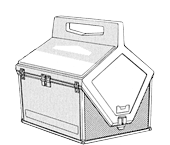
A cool box that contains a perfectly preserved brain,
a slip of paper that reads “search [for] my body”
,
an ID photo of the rookie who has recently gone missing—
That is how it all begins.
One More Introduction
The third criminal case in the series is the opening act of volume 2, spans 113 pages and is simply labelled “Top Secret — 2002”, presumably in reference to its year of creation, as the story takes place in 2060. It is still an introduction of sorts, and can be read without prior knowledge as the mechanics of the central MRI scanner are explained in detail once more. 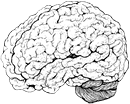 In short, it is a device that grants access to the visual memories of any recently deceased person from up to five years before their death, provided that their brain is undamaged and has been suitably preserved. Information obtained from their reproduced memory is used by the police to crack unsolved cases. To recap:
Between its first use case in 2055 and the spring of 2060, the MRI scanner as a new investigation method has been employed in ten cases, sporting a success rate of nearly 100 %. The enormous threat that the method poses to privacy and human dignity raises opposition from conservatives, human rights organizations, ethics commissions and the general public alike. Weighing the ethical choices, the government acknowledged that not all crimes can be solved through conventional methods, and conceded the use of the MRI scanner in the investigations of the most atrocious of crimes as well as cases of great public interest. For this sake, a special unit within the National Research Institute of Police Science was established. They are the Ninth, short for the 9th Laboratory of Forensic Medicine. Comprised of a handful of elite graduates, they are the sole unit in all of Japan to be authorized with the use of this highly controversial technology.
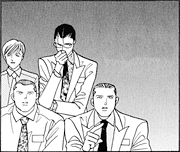
While the very first case was a pilot chapter featuring a different protagonist, and the second introduced the two main characters of the series, this one establishes the team of the Ninth at the precinct. It does so in broad strokes, as the majority of the eight team members never gain a distinct shape or voice over the course of the series. (The manga is very focused on its two main characters and the heavy homoerotic subtext.) More specifically, the case sketches out the Ninth’s daily work with the MRI scanner and their labour’s psychological toll.
The case makes for a suitable standalone read also because it has very strong themes that are entirely its own, not shared by any other case in the series, making it another standout Shimizu short story — one that, needless to say, numbers among my favourites. That is a quality I appreciate about The Top Secret: It establishes something, which from then on is understood as fact in its worldbuilding, no reiteration necessary. (The recurring explanations of the MRI scanner’s basic functionality in the first half of the series are an exception, necessary probably to draw in new readers during the manga’s first serialization, which in Japan happens chapter-wise in anthology magazines.) The cases hereafter do not take the psychological toll so present in case two and three up again. And though dream images come up again in later MRI investigations, this case’s unique dream “mechanic” is never repeated, even though an entire series could very well be constructed around the concept alone.
A Story of Hauntings
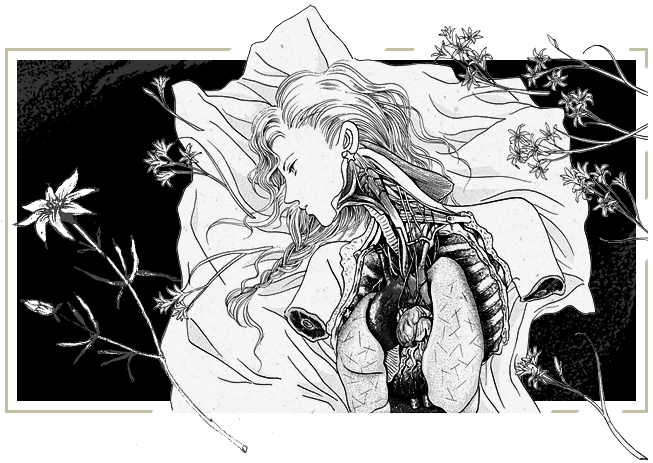
“Top Secret — 2002” is, superficially speaking, the case of a murder and rape series of high public interest that recently occurred in Shibuya. The killer targeted only girls and harvested their bones, eyes and jewellery. With his brain now in police custody, the investigation may yet advance.
At the same time, it is the story of the Ninth as its members race the clock in search of their newest member, who has gone missing some days ago, desperate to find her in hope that her life may still be saved.
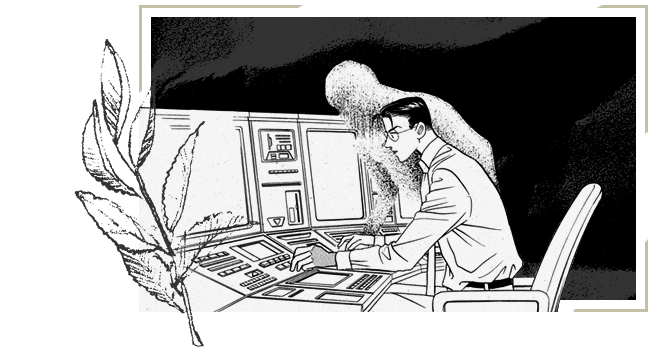
More importantly, it is the story of the protagonist Ikko Aoki as he, sleep-deprived and guilt-ridden, retraces his steps to track down the new subordinate he lashed out at, all the while wondering whether her spirit is haunting his every sleeping and waking moment to drag him to his death.
Finally, it is also the story of the rookie Nanako Amachi, who followed up on her own instincts out of a dutiful desire to help — or make amends to? — her much-respected senior, who would neither hear her out nor accept her apology over an earnest mistake.
Framed by Aoki’s perspective, the mood of the case is established from the onset and hangs heavy over the entire ordeal: It is a story equally of hauntings as it is of failings, marked by disorientation, dread and panic as the line between dreams and reality is blurred. Wrecked by recurring nightmares of Amachi to the point of fearing sleep, Aoki tries to recall when her face first started to haunt his dreams.
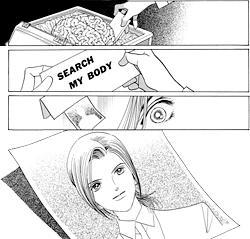
Days prior, a cool box is delivered to the doorstep of the 9th Laboratory, addressed to police superintendent Tsuyoshi Maki, head of the Ninth. Designed specifically for the transport of organs, it contains: a frozen brain alongside Amachi’s ID photo and a message card — “search [for] my body”
.
The autopsy results confirm the organ to be Amachi’s cerebral cortex. Judging by the incision and the sutures, the extraction was not the work of an amateur. For lack of information regarding the circumstances, an MRI investigation is ordered, the first case where the Ninth would peer into a colleague’s brain. A small hope remains: If the brain stem has been left intact, it may continue to regulate vital functions of the body even in the absence of the cerebral cortex. Somewhere out there, Amachi may still be alive, waiting to be found and rescued.
Aoki remembers: In his last conversation with Amachi days before the disturbing delivery, it was his cold shoulder that drove her away. Now, worried sick over his colleague and scared for his own life, he tracks the clues of the case with the same persistence and desperation that his nightmares chase him, using every bit of energy his exhausted body can summon to find hers.
But who exactly was Amachi?
Let us turn back the clock once more.
In lawnchairs under stars. On the dock
at midnight, anchored by winter clothes,
we lean back to read the sky. Your face white
in the womb light, the lake’s electric skin.