your sleep as its smooth dark wave
slides over my headand walk with you through that lucent
wavering forest of bluegreen leaves
with its watery sun & three moons
towards the cave where you must descend,
towards your worst fear
Of Dreams and Spirits
After Amachi’s brain is delivered to the Ninth and the MRI investigation commences, the phenomena that fascinated her catch up with Aoki, becoming increasingly relevant.
The Mind’s Eye
As established on Refugium, the MRI scanner that guides the series’ many cases allows Shimizu to tell intimate stories of lonely individual fates, chiefly because it lays bare the subjectivity of every person’s singular perception.
The pilot chapter demonstrated the MRI scanner’s capacity to detect and distinguish emotion in the gaze of the beholder, and the nonverbal display thereof marked the turning point of its cautionary tale. In the second story, the MRI scanner rendered hallucinations induced by abnormal mental states to the screen, emphasizing once more that it does not reproduce objective truth. Both stories utilize relatively heavy triggers (affection, attraction; hypnotic suggestion, terror) to evoke conscious emotions and actions (shame; flight, suicide).
The third criminal case discussed here adds another layer to the technology’s subjectivity, but approaches it from a different, more subtle angle. As Amachi learned from the Ninth early on, images of the things in a person’s immediate field of vision that are reproduced by the MRI scanner turn blurry whenever their gaze had lost its focus. The technology thereby reveals their absorption in thought, even as the thoughts themselves cannot be reproduced. In contrast, something pictured in a person’s mind may take some sort of shape on the screen depending on their level of concentration, be it an object or the face of a loved one — a projection of images perceived by their mind’s eye rather than their (physical) eyes alone.
Following this, even the dreams of the departed, no different than images “seen” by the mind’s eye, can be viewed. What’s more, as the MRI scanner also catches background, non-focal and unconsciously perceived sights, it is capable of retrieving dream images even when the dreamer forgot them upon waking, as is almost always the case. That said, dreams are exceptionally rarely consulted in MRI investigations as they (along with the subsequent dream interpretation and psychoanalysis) are largely deemed of no value in the solving of crimes, not to mention that the reproduced dream images are qualitatively inferior to any images perceived by the waking mind.
Needless to say, Amachi was utterly enthralled by the philosophical implications of this strange technology:
When we think hard about something, it appears as an image. So, if we think even harder about it, could it materialize and reach someone? In that case, how would we describe that “thing”? Is it a spirit? A soul?
Lingering Spirit
The results yielded by the MRI scanner soon reveal that Amachi — Amachi’s visual memory as preserved by her brain — was used to deliver a targeted threat to the police: Should the Ninth continue to look into the Shibuya murder series, so the note Amachi was made to read, another victim from among their ranks may just follow. Unfortunately, this is where the investigation reaches a standstill, as Amachi, without so much as catching a glimpse of the perpetrator’s face, was knocked unconscious in a public park and remained so until the extraction of her brain.
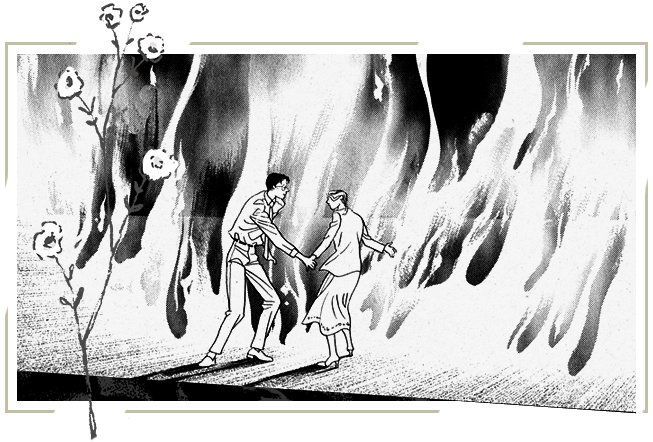
Had she not gone missing, she might, in her own absurd way, have been delighted to learn that she herself appears as something akin to a spirit throughout the story, for Aoki sees her everywhere, the ghost of her presence clinging to him relentlessly:
- Amachi who appears to him in broad daylight as he tries to catch a break, nothing more but a trick of the light;
- Amachi who sits behind him late at night and persistently begs him to let her help, Amachi who gets up from her chair and creeps up to him, Amachi the specter, face melting off, her brain dropping on his busy typing hand;
- Amachi who, faceless and brainless, pleads with him to look for her body, to please please find it soon, and tries to pull him with her into a sea of fire;
- Amachi who waits for him to nod off to strangle him.
What are these hallucinations and nightmares if not Amachi come back as a spirit, her will and resentment allowing her to transcend the bounds of the MRI scanner’s recordings to put an end to his life?

The Realm of Dreams
It takes Maki’s sharp reprimand and command to go and have a good long sleep for Aoki to snap out of it. He realizes that it is not Amachi who is causing him all the nightmares and sleep loss, but the circumstances in which his exhausted body nods off: the wet towel (the melted brain on his hand), the broken air conditioner in the hot data room (the sea of fire), his own tight necktie (the strangling sensation).
Comprehending that sensations in physical reality may directly impact one’s dreaming, Aoki puts a bold theory forward: In the absence of concrete visual memory to advance the investigation, the Ninth should try to look into Amachi’s dreams as a last resort — the images manifested by her mind as she lay unconscious, asleep for a day before her brain was separated from her body.
“We remain conscious when we sleep! Though our eyes are closed, the body remains in contact with the outside world! It continues to be stimulated by temperature, smell, sound and light! […] Dreams are a reflection of our physical and mental state at the moment. We don’t always have dreams like that of course. In fact, they are quite rare. We don’t even dream during non-REM sleep. But it’s worth a try. No… It’s our last resort.”
And so the Ninth plunges into the dream recordings.
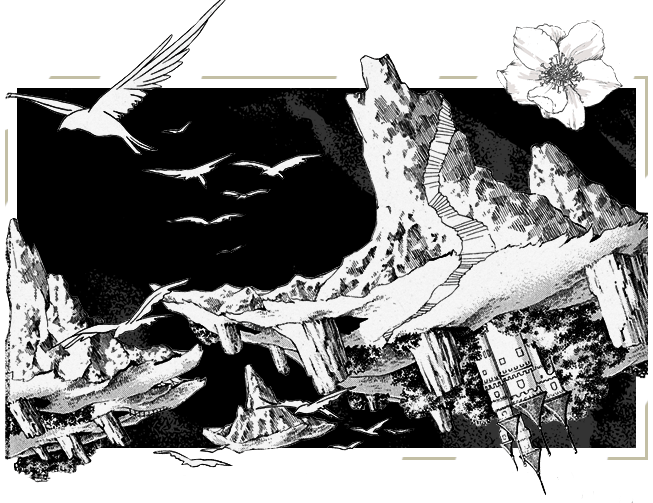
Entering Amachi’s dreamscape comes as a revelation to the entire team: vast skies, floating islands from which streams and waterfalls spring, protruding cliffs and mountains, lush forests, upside-down palaces, steps that lead nowhere, planetary rings and moons in plain sight, birds in flight — splendour that leaves them speechless. Aoki’s silent awe says it all:
Why… Why didn’t she go into film or art? […] — The beauty of her dream surprised me. This being Amachi, I had expected a nightmare filled with corpses. This dream is rich and fantastic.
As humans sleep in cycles of about 90 minutes, going through phases of light, deep and REM sleep, the number of dreams viewed allows the team to infer the passage of time in reality. When the dreamscape shifts, the perspective becomes Amachi’s in the sequence of scenes that follows: A Japanese bathtub made of cypress in a Japanese forest, the water in the tub turned to ice. Amachi, huddled in the tub, naked, shivering. A desert landscape, a world of ice, all colour drained. Aoki’s figure seated on an office chair in the distance just as on the day they last saw each other, back turned, tense.
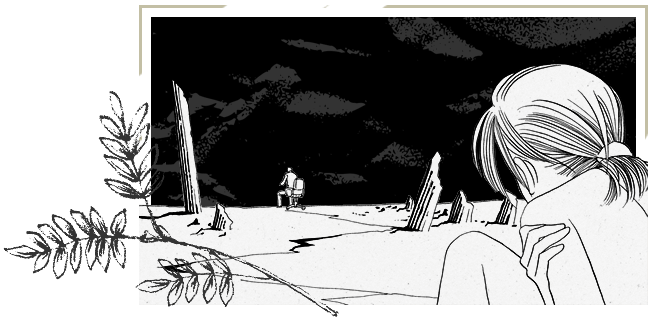
Amachi is holding something in her hand, drawing closer to the sitting Aoki from behind. She stands still without daring to approach him, afraid, shaking — afraid of Aoki, of being berated again. When at last she reaches out to touch him, he topples over, dead already.
When I was nine and crying from a dream
you said words that hid my fear.
Above us the family slept on,
mouths open, hands scrolled.
Twenty years later your tears burn the back of my throat.
Memory has a hand in the grave up to the wrist.
Earth crumbles from your fist under the sky’s black sieve.
We are orphaned, one by one.